CSNK2A1-NanoLuc® Fusion Vector

Kinase Fusion Vector for NanoBRET® Target Engagement
- Transfection-ready DNA to express full-length CSNK2A1 kinase fused to NanoLuc® Luciferase
- Measures kinase target engagement in live cells
- Use with NanoBRET® TE Intracellular Kinase Assay, Adherent Format protocol

Catalog Number:
Size
Catalog Number: NV2981
Esprimere fusioni NanoLuc®-Kinase a lunghezza piena in cellule di mammifero
Il vettore di fusione CSNK2A1-NanoLuc® contiene la regione codificante della luciferasi NanoLuc® fusa al C-terminus della chinasi CSNK2A1 umana. È stato progettato per essere utilizzato con il protocollo NanoBRET™ Target Engagement (TE) Intracellular Kinase Assay, Adherent Format, in cui il plasmide può essere trasfettato in varie linee cellulari per l'analisi del target CSNK2A1. I vettori di fusione della chinasi NanoLuc® luciferasi sono forniti pronti per la trasfezione. Il promotore CMV guida l'espressione della proteina di fusione NanoLuc® chinasi a lunghezza piena.
Dettagli del vettore:
- Nome del gene: CSNK2A1
- Sequenza
- Saggio raccomandato: NanoBRET™ TE Intracellular Kinase, K-10
- Dati di esempio utilizzando il tracciante: K-10
Informazioni sui nomi dei vettori di fusione delle chinasi
Il posizionamento di NanoLuc® a 5´ o 3´ del gene della chinasi è ottimizzato per l'uso con i saggi NanoBRET™ TE e si riflette nel nome del vettore. Ad esempio, NanoLuc®-kinase implica che NanoLuc® si trova a 5´ del gene della chinasi (all'N-terminus della chinasi). Analogamente, kinase-NanoLuc® implica che NanoLuc® è a 3´dal gene della chinasi (al C-terminus della chinasi).
Saggi di chinasi intracellulari NanoBRET™ Target Engagement (TE)
I saggi di chinasi intracellulare NanoBRET™ TE possono analizzare l'affinità dei composti in esame mediante lo spostamento competitivo di un tracciante fluorescente NanoBRET™ legato reversibilmente a una proteina di fusione NanoLuc®- chinasi nelle cellule. L'introduzione di composti di prova concorrenti determina una diminuzione dose-dipendente del segnale NanoBRET™ per stimare l'affinità intracellulare contro la proteina bersaglio. Il tracciante NanoBRET™ usato è determinato dalla scelta del vettore di fusione della chinasi NanoLuc®. La tabella di selezione del vettore chinasi mostra quale saggio NanoBRET™ Tracer è corretto per ciascun vettore di fusione chinasi.
Protocols
No protocols available
Specifications
Catalog Number:
What's in the box
| Item | Part # | Choose a size | Concentration |
|---|---|---|---|
CSNK2A1-NanoLuc® Fusion Vector |
NV298A | 1 × 20μg | 1μg/μl |
SDS
Search for SDSCertificate of Analysis
Use Restrictions
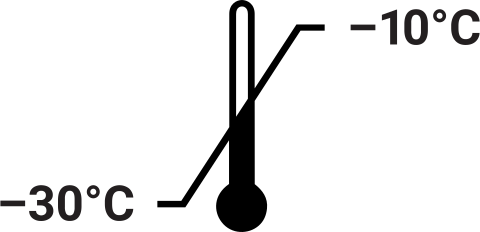
For Research Use Only. Not for Use in Diagnostic Procedures.Storage Conditions
NanoLuc® ORF TE Vector Limited Use Label License
BY USE OF THIS PRODUCT, RESEARCHER AGREES TO BE BOUND BY THE TERMS OF THIS LIMITED USE LABEL LICENSE. If researcher is not willing to accept the terms of this label license, and the product is unused, Promega will accept return of the unused product and provide researcher with a full refund.
Researcher may use this product for research use only; no transfer or commercial use of this product is allowed. Commercial use means any and all uses of this product by a party in exchange for consideration, including, but not limited to (1) use in further product manufacture; (2) use in provision of services, information or data; and (3) resale of the product, whether or not such product is resold for use in research. Researcher shall have no right to modify or otherwise create variations of the nucleotide sequence of the luciferase gene. No other use of this product is authorized without the prior express written consent of Promega.
In addition, researcher must:
(1a) use Nano-Glo®-branded luminescent assay reagents (LARs) for all determinations of luminescence activity of this product; or
(1b) contact Promega to obtain a license for use of the product with LARs not manufactured by Promega.
For uses of this product (NanoLuc® ORF Vector) for energy transfer (such as bioluminescence resonance energy transfer), researcher must:
(2a) use NanoBRET®-branded luminescent assay reagents (LARs; e.g., NanoBRET® Nano-Glo® Substrate), Intracellular TE Nano-Glo® Substrate/Inhibitor or Intracellular TE Nano-Glo® Vivazine®/Inhibitor for all determinations of luminescent activity; and
(2b) use NanoBRET®-branded energy acceptors (e.g., NanoBRET® tracers, NanoBRET® dyes, BRET-optimized HaloTag® ligands) for all determinations of energy transfer activity; or
(2c) contact Promega to obtain a license for use of the product for energy transfer assays using energy acceptors not manufactured by Promega. No license is needed if the energy transfer acceptor is a genetically encoded autofluorescent protein.
With respect to any uses outside this label license, including any diagnostic, therapeutic, prophylactic or commercial uses, please contact Promega for supply and licensing information. PROMEGA MAKES NO REPRESENTATIONS OR WARRANTIES OF ANY KIND, EITHER EXPRESSED OR IMPLIED, INCLUDING FOR MERCHANTABILITY OR FITNESS FOR A PARTICULAR PURPOSE, WITH REGARD TO THE PRODUCT. The terms of this label license shall be governed under the laws of the State of Wisconsin, USA.
U.S. Pat. Nos. 8,557,970, 8,669,103, 9,777,311, 9,840,730, 9,951,373, 10,233,485, 10,633,690, 10,774,364, 10,844,422, 11,365,436, 11,661,623, 11,667,950; European Pat. Nos. 2456864, 2635595, 2990478, 3181687, 3409764; Japanese Pat. Nos. 6038649, 6155424, 6227615, 6374420, 6539689; and other patents and patents pending.
Resources
No related resources found