CellTox™ Green Cytotoxicity Assay


Real-Time Cell Death Assay With Multiplexing Compatibility
- Accurate cytotoxicity determination in exposures out to 72 hours
- Flexible protocol allows kinetic analysis or endpoint determination
- Multiplex with luminescent assays to obtain more data per well

Catalog Number:
Size
Catalog Number: G8741
Catalog Number: G8742
Catalog Number: G8743
Catalog Number: G8731

Monitoraggio della morte cellulare in tempo reale con il saggio di citotossicità CellTox™ Green
I saggi di citotossicità basati sulla rilevazione di biomarcatori rilasciati nel terreno di coltura possono sottostimare la citotossicità in caso di esposizioni a lungo termine di 72 ore o più, a causa della limitata stabilità del biomarcatore rilevato. Il saggio di citotossicità CellTox™ Green fornisce un metodo semplice, rapido e accurato per determinare gli effetti tossici durante o dopo l'esposizione a lungo termine delle cellule in coltura. CellTox Green può essere combinato con altri metodi in saggi multipli per determinare il meccanismo della tossicità ed è facilmente scalabile da 96 a 1536 pozzetti.
Scoprite come il saggio di citotossicità CellTox™ Green può essere utilizzato per valutare la tossicità dei farmaci negli organoidi.
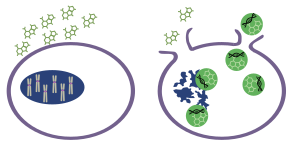
Il colorante verde CellTox™ lega il DNA di cellule con integrità di membrana compromessa.
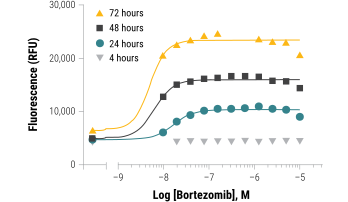
Eseguire misure di citotossicità cinetica per determinare l'inizio della tossicità
Aumento della citotossicità in funzione della dose e dell'esposizione
Nell'esperimento qui illustrato, il bortezomib ha causato una citotossicità apprezzabile nelle cellule K562 tra i punti temporali di 4 e 24 ore. La fluorescenza additiva in punti temporali successivi indica una continua perdita di integrità della membrana che si verifica in funzione della citotossicità contro le cellule rimanenti. Il colorante verde CellTox™ è stato aggiunto al momento della semina.
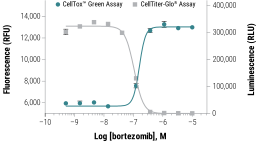
Multiplex con test di vitalità cellulare per ottenere dati più informativi per pozzetto
Misurare la citotossicità e la vitalità
In questo caso, il colorante verde CellTox™ è stato miscelato con le cellule K562, che sono state piastrate e poi dosate con il composto. Al termine dell'esposizione di 72 ore è stato aggiunto il reagente per il test di vitalità cellulare CellTiter-Glo® ed è stata misurata la luminescenza (vitalità). Queste due misure inverse della salute delle cellule hanno dato luogo a un accordo sull'EC50.
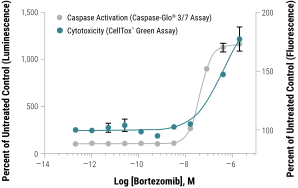
Determinare la tempistica appropriata delle analisi della caspasi
CellTox™ Green può essere utilizzato in modalità cinetica per determinare l'inizio della citotossicità, seguito dal multiplexing con il saggio Caspase-Glo® 3/7 Assay nello stesso pozzetto del campione per confermare l'attivazione della caspasi-3/7 al momento opportuno.
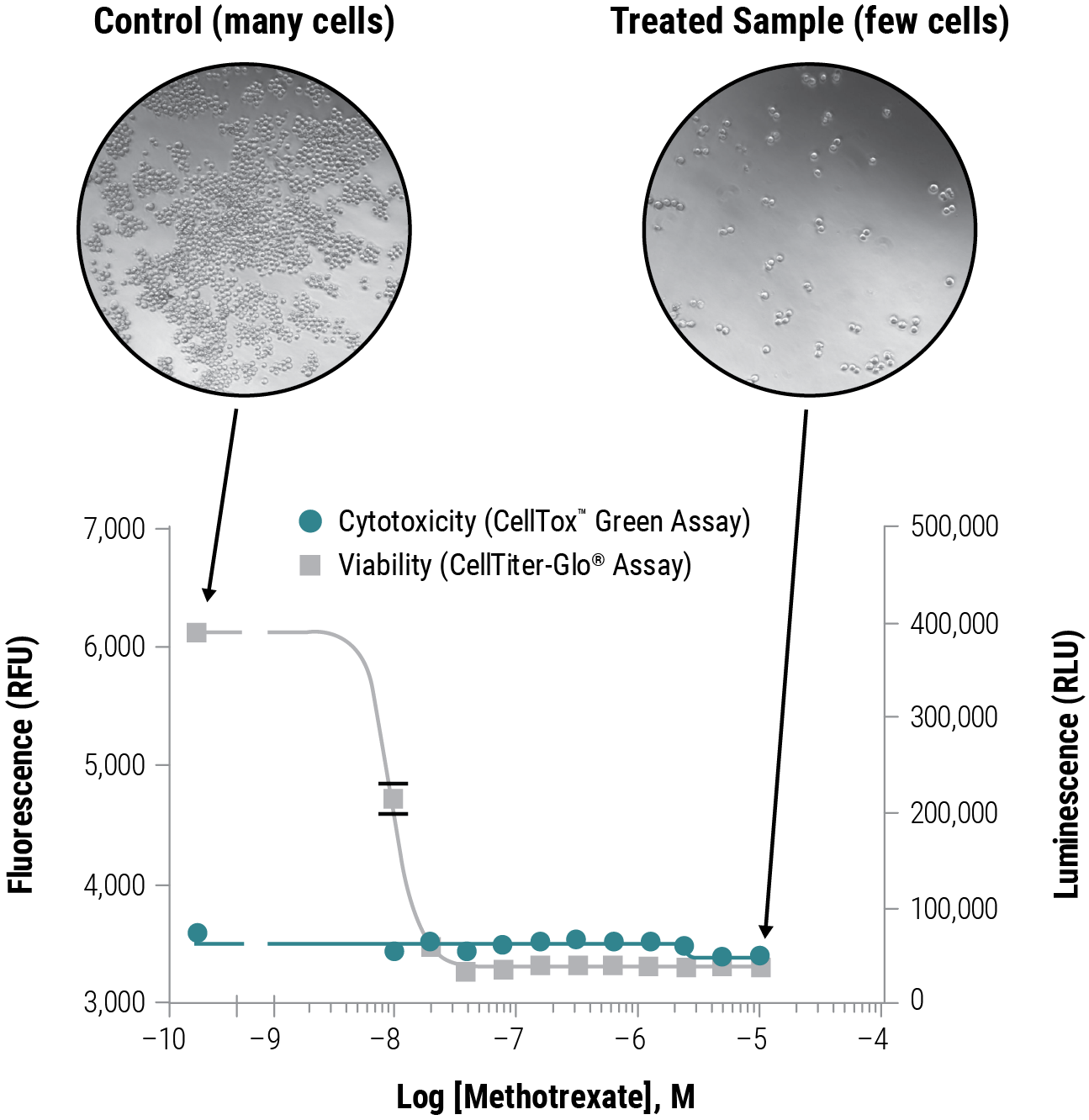
Distinguere tra effetti citotossici e citostatici
In questo esempio, le cellule K562 sono state esposte al metotrexato, un composto antiproliferativo, per 72 ore. Per determinare la citotossicità è stato aggiunto il colorante verde CellTox™, quindi il reagente CellTiter-Glo® è stato aggiunto allo stesso pozzetto per la determinazione della vitalità. Un'analisi della vitalità da sola avrebbe segnalato erroneamente il composto come citotossico a causa del minor numero di cellule nel campione trattato rispetto al controllo non trattato, che ha continuato a proliferare. Il multiplexing con un saggio di citotossicità non rivela alcun cambiamento nel segnale come risultato della compromissione dell'integrità della membrana, indicando l'inibizione della crescita e non la citotossicità.
Dopo diversi mesi di tentativi di sviluppare un robusto test di citotossicità cellulare, abbiamo sempre osservato un'elevata variabilità sull'asintoto superiore della curva dose-risposta. In base alle raccomandazioni di Promega, abbiamo sostituito il nostro precedente reagente per il rilevamento della citotossicità con il reagente CellTox™ Green Cytotoxicity, che ha risolto direttamente i nostri problemi. Il test basato sulle cellule è ora completamente validato con questo reagente nella nostra azienda.
Dr. Fabian Vandermeers, Sr R&D Technical Leader, Quality Assistance S.A.
Protocols
Complete Protocol
Specifications
Catalog Number:
What's in the box
| Item | Part # | Choose a size |
|---|---|---|
|
Lysis Solution |
G182B | 1 × 0.5ml |
|
Assay Buffer |
G610A | 1 × 10ml |
CellTox™ Green Dye, 1,000X |
G873A | 1 × 20μl |
SDS
Search for SDSCertificate of Analysis
Use Restrictions
For Research Use Only. Not for Use in Diagnostic Procedures.Storage Conditions
What's in the box
| Item | Part # | Choose a size |
|---|---|---|
|
Lysis Solution |
G182B | 1 × 0.5ml |
|
Assay Buffer |
G610B | 1 × 50ml |
CellTox™ Green Dye, 1,000X |
G873A | 5 × 20μl |
SDS
Search for SDSCertificate of Analysis
Use Restrictions
For Research Use Only. Not for Use in Diagnostic Procedures.Storage Conditions
What's in the box
| Item | Part # | Choose a size |
|---|---|---|
|
Lysis Solution |
G182B | 1 × 0.5ml |
|
Assay Buffer |
G610B | 2 × 50ml |
CellTox™ Green Dye, 1,000X |
G873B | 1 × 200μl |
SDS
Search for SDSCertificate of Analysis
Use Restrictions
For Research Use Only. Not for Use in Diagnostic Procedures.Storage Conditions
What's in the box
| Item | Part # | Choose a size |
|---|---|---|
CellTox™ Green Dye, 1,000X |
G873B | 1 × 200μl |
SDS
Search for SDSCertificate of Analysis
Use Restrictions
For Research Use Only. Not for Use in Diagnostic Procedures.Storage Conditions
Resources
Articles
Citations
-
Elongation factor 2 kinase promotes cell survival by inhibiting protein synthesis without inducing autophagy.
2016
Cell Signal
-- -
High USP6NL levels in breast cancer sustain chronic AKT phosphorylation and GLUT1 stability fueling aerobic glycolysis.
2018
Cancer Res.
-- -
Cytotoxicity Assays: In Vitro Methods to Measure Dead Cells.
2019
Assay Guidance Manual
-- -
APD-containing cyclolipodepsipeptides target mitochondrial function in hypoxic cancer cells.
2018
Cell Chemical Biology
-- -
Real-time cell toxicity profiling of Tox21 10K compounds reveals cytotoxicity dependent toxicity pathway linkage
2017
PLos ONE
-- -
High USP6NL Levels in Breast Cancer Sustain Chronic AKT Phosphorylation and GLUT1 Stability Fueling Aerobic Glycolysis.
2018
Cancer Res.
-- -
The nucleoside analog GS-441524 strongly inhibits feline infectious peritonitis (FIP) virus in tissue culture and experimental cat infection studies.
2018
Veterinary Microbiology
-- -
Control of leucine-dependent mTORC1 pathway through chemical intervention of leucyl-tRNA synthetase and RagD interaction.
2017
Nat. Commun.
-- -
Resveratrol-induced autophagy is dependent on IP3Rs and on cytosolic Ca2.
2017
Biochim. Biophys. Acta
-- -
Gas6-Axl signaling in presence of Sunitinib is enhanced, diversified and sustained in renal tumor cells, resulting in tumor-progressive advantages.
2017
Exp. Cell Res.
-- -
The human cancer cell active toxin Cry41Aa from Bacillus thuringiensis acts like its insecticidal counterparts.
2017
Biochem. J.
-- -
Oncogenic β-catenin and PIK3CA instruct network states and cancer phenotypes in intestinal organoids.
2017
J. Cell Biol.
-- -
Imaging oxygen in neural cell and tissue models by means of anionic cell-permeable phosphorescent nanoparticles.
2015
Cell Molec. Life Sci.
-- -
NAMPT inhibition sensitizes adenocarcinoma cells to tumor-selective, PAR-independent metabolic catastrophe and cell death induced by β-lapachone.
2014
Cell Death Dis.
-- -
Impact of p53 status on radiosensitization of tumor cells by MET inhibition–associated checkpoint abrogation.
2015
Mol. Cancer Res.
-- -
Brincidofovir (CMX001) inhibits BL polyomavirus replication in primary human urothelial cells.
2015
Antimicrob. Agents Chemother.
-- -
Development and validation of a luminescence-base, medium throughput assay for drug screening in Schistosoma mansoni.
2015
PLOS Negl. Trop. Dis.
-- -
In vitro ischemia decreases histone H4K16 acetylation in neural cells.
2015
FEBS Lett.
-- -
Genetic polymorphisms associated with hearing threshold shift in subjects during first encounter with occupational impulse noise.
2015
PLos ONE
-- -
Glutamine synthetase activity fuels nucleotide biosynthesis and supports growth of glutamine-restricted glioblastoma.
2015
Nat. Cell Biol.
-- -
The role of thioredoxin reductase and glutathione reductase in plumbagin-induced, reactive oxygen species-mediated apoptosis in cancer cell lines.
2015
Eur. J. Pharmacol.
-- -
New small molecules targeting apoptosis and cell viability in osteosarcoma.
2015
PLos ONE
-- -
Efficient elimination of CD103-expressing cells by anti-CD103 antibody drug conjugates in immunocompetent mice.
2015
Int. Immunopharmacol.
-- -
Precision cancer medicine in the acoustic dispensing Era: Ex vivo primary cell drug sensitivity testing.
2016
J. Lab. Autom.
-- -
Topoisomerase IIα mediates TCF-dependent epithelial-mesenchymal transition in colon cancer.
2016
Oncogene
-- -
NRF2 regulates serine biosynthesis in non-small cell lung cancer.
2015
Nat. Genet.
-- -
Novel benzoxazines as inhibitors of angiogenesis.
2015
Invest. New Drugs
-- -
DNA damage-induced apoptosis suppressor (DDIAS), a novel target of NFATc1, is associated with cisplatin resistance in lung cancer.
2016
Biochim. Biophys. Acta
-- -
Auranofin is an apoptosis-simulating agent with in vitro and in vivo anti-leshmanial activity.
2014
ACS Chemical Biology
-- -
Analysis of toxic amyloid fibril interactions at natively derived membranes by ellipsometry.
2015
PLos ONE
-- -
Glutamine drives glutathione synthesis and contributes to radiation sensitivity of A549 and H460 lung cancer cell lines.
2016
Biochim. Biophys. Acta
-- -
Engineering persister-specific antibiotics with synergistic antimicrobial functions.
2014
ACS Nano
-- -
Molecular mechanism for the control of eukaryotic elongation factor 2 kinase by pH: Role in cancer cell survival.
2015
Mol. Cell. Biol.
-- -
RBM45 modulates the antioxidant response in amyotrophic lateral sclerosis through interactions with KEAP1.
2015
Mol. Cell. Biol.
-- -
Low-temperature plasma treatment induces DNA damage leading to necrotic cell death in primary prostate epithelial cells.
2015
Br. J. Cancer
-- -
Inhibition of Pseudomonas aeruginosa biofilm formation on wound dressings.
2015
Wound Repair Regen.
-- - See all citations
Related Products
Similar Products
Test di citotossicità LDH-Glo™
Test LDH basato sulla bioluminescenza per la rilevazione sensibile della citotossicità in campioni a basso numero di cellule, compresi i microtessuti 3D.
J2380, J2381
Test ToxGlo™ mitocondriale
Un test efficace per prevedere la potenziale disfunzione mitocondriale.
G8000, G8001
Sistema di analisi Caspase-Glo® 3/7
Un test luminescente su piastra di facile utilizzo per la rilevazione dell'attività della caspasi-3/7.
G8090, G8091, G8093, G8092
Test CytoTox-ONE™ per l'integrità omogenea della membrana
Un metodo fluorimetrico omogeneo basato su LDH per quantificare le cellule non vitali.
G7890, G7891, G7892
Frequently Used With
Test di citotossicità CytoTox-Fluor
Un'analisi fluorescente omogenea, con aggiunta di un singolo reagente, che misura il numero relativo di cellule morte nelle popolazioni cellulari.
G9260, G9261, G9262
Test di vitalità cellulare CellTiter-Fluor
Un test di vitalità cellulare non litico e fluorescente con capacità multipla.
G6080, G6081, G6082
Test di vitalità cellulare CellTiter-Blue
Monitorate la vitalità cellulare con questo test omogeneo, a base di resazurina e fluorescente.
G8080, G8081, G8082
GloMax® Discover System
High-performance microplate reader for detecting luminescence, fluorescence and absorbance.
GM3000