Proteinase K (PK) Solution
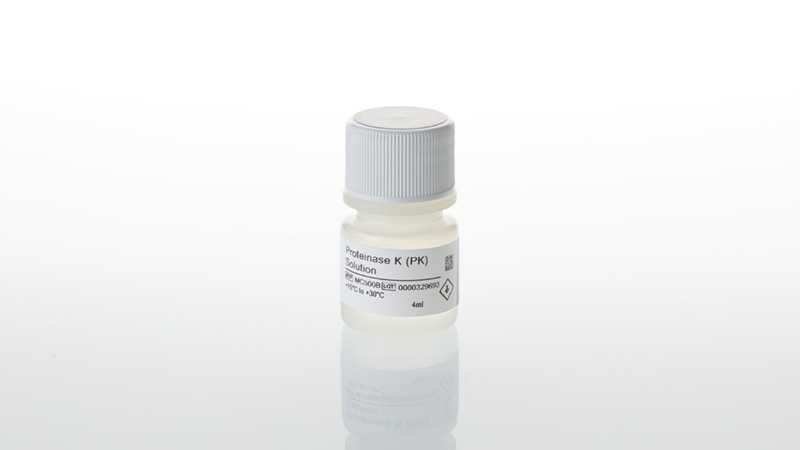
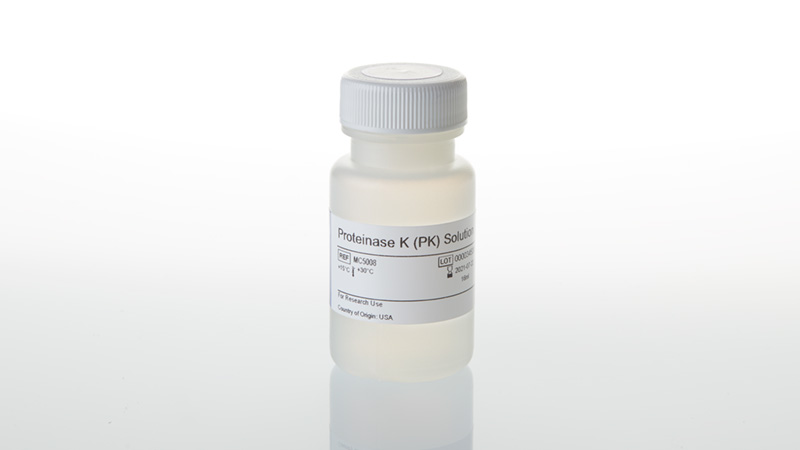
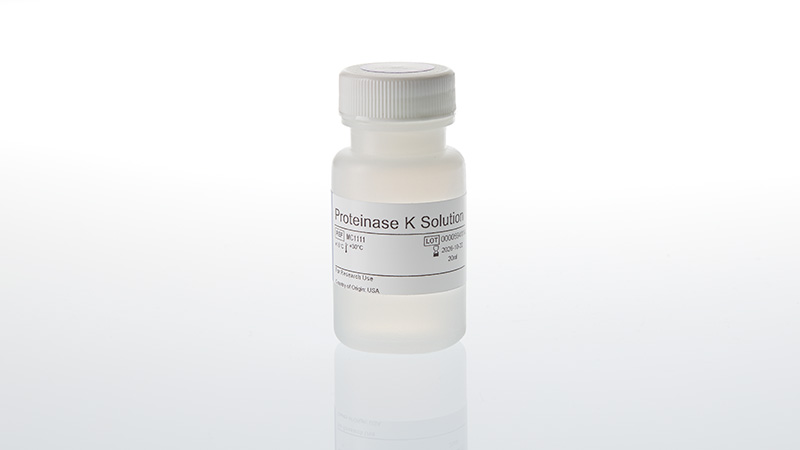
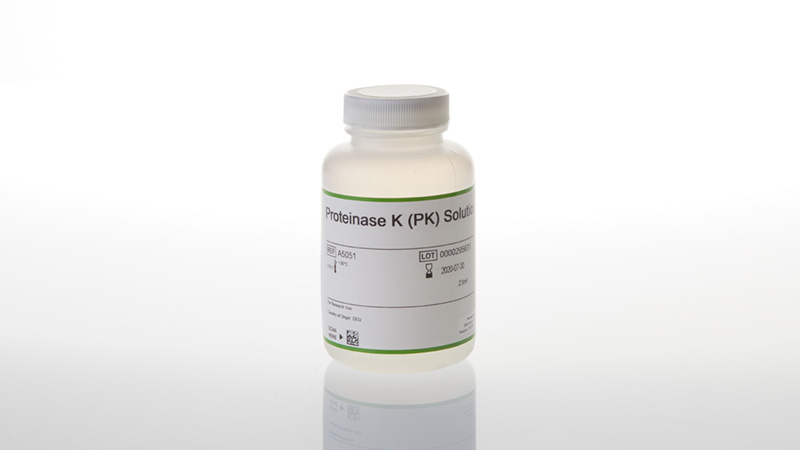
Stable at Room Temperature and Easy to Use
- Active over pH range 4.3–12.0 in 0.5% SDS or 1% Triton® X-100
- Retains >80% activity at temperatures up to 60°C
- No resuspension or thawing before use
- Supplied at a concentration of 20mg/ml

Catalog Number:
Size
Catalog Number: MC5005
Catalog Number: MC5008
Catalog Number: MC1111
Catalog Number: A5051
La proteinasi K, prodotta dal fungo Tritirachium album Limber, è una serina proteasi che presenta un'ampia attività di scissione. Scinde i legami peptidici adiacenti al gruppo carbossilico degli aminoacidi alifatici e aromatici ed è utile per la digestione generale delle proteine nei campioni biologici. È stata purificata per rimuovere le attività di RNasi e DNasi. La stabilità della Proteinasi K in urea e SDS e la sua capacità di digerire le proteine native la rendono utile per una serie di applicazioni, tra cui la preparazione del DNA cromosomico per l'elettroforesi su gel a campo pulsato, il fingerprinting proteico e la rimozione delle nucleasi da preparazioni di DNA e RNA. Una tipica concentrazione di lavoro per la Proteinasi K è 50-100μg/ml.
Formulazione: La soluzione di Proteinasi K (PK) è fornita alla concentrazione di 20mg/ml in 10mM Tris-HCl (pH 7,5), 1mM di cloruro di calcio e 50% di glicerolo.
Scaricate la nostra Scheda Verde per saperne di più sulle caratteristiche che rendono questo prodotto un prodotto ecologicamente preferibile:
Riferimenti:
- Ebeling, W. et al. (1974) Eur. J. Biochem. 47, 91-7.
- Schwartz, D.C. e Cantor, C.R. (1984) Cell 37, 67-75.
- Cleveland, D.W. et al. (1977) J. Biol. Chem. 252, 1102-6.
- Hames, B.D. (1981) In: Gel Electrophoresis of Proteins: A Practical Approach, B.D. Hames and D. Rickwood, eds., IRL Press, Oxford, 219.
- Herrmann, B.G. e Frischauf, A.M. (1987) Meth. Enzymol. 152, 180-3.
- Lee, J.J. e Costlow, N.A. (1987) Meth. Enzymol. 152, 633-48.
- Sambrook, J. et al. (1989) Molecular Cloning: A Laboratory Manual, Vol. 3, Cold Spring Harbor Laboratory Press, Cold Spring Harbor, NY.
- Sweeney, P.J. e Walker, J.M. (1993) Enzimi della biologia molecolare. In: Methods in Molecular Biology, Vol. 16, M.M. Burrell, ed., Humana Press, Inc., Totowa, NJ, 305.
Protocols
No protocols available
Specifications
Catalog Number:
What's in the box
| Item | Part # | Choose a size | Available Separately |
|---|---|---|---|
|
Proteinase K (PK) Solution |
MC500B | 1 × 4ml | View Product |
SDS
Search for SDSCertificate of Analysis
Use Restrictions
For Research Use Only. Not for Use in Diagnostic Procedures.Storage Conditions

What's in the box
| Item | Part # | Choose a size | Concentration | Available Separately |
|---|---|---|---|---|
|
Proteinase K (PK) Solution |
MC5008 | 1 × 16ml | 20mg/ml | View Product |
SDS
Search for SDSCertificate of Analysis
Use Restrictions
For Research Use Only. Not for Use in Diagnostic Procedures.Storage Conditions
SDS
Search for SDSCertificate of Analysis
Use Restrictions
For Research Use Only. Not for Use in Diagnostic Procedures.Storage Conditions
What's in the box
| Item | Part # | Choose a size | Available Separately |
|---|---|---|---|
Proteinase K (PK) Solution |
A5051 | 1 × 23ml | View Product |
SDS
Search for SDSCertificate of Analysis
Use Restrictions
For Research Use Only. Not for Use in Diagnostic Procedures.Storage Conditions
Resources
Articles
Related Products
Similar Products
Frequently Used With
Maxwell® RSC DNA FFPE Kit
Extracts DNA from FFPE tissue samples using the Maxwell® RSC Instrument.
AS1450, ASB1450
Maxwell® RSC RNA FFPE Kit
Purifies RNA from FFPE tissue sections using the Maxwell® RSC Instrument.
AS1440
Maxwell® HT Genomic DNA Kit
Platform solution with built-in flexibility for consistent and reliable DNA extraction from different sample types and input amounts for use in a variety of sensitive downstream applications.
A6050
ReliaPrep™ Large Volume HT gDNA Isolation System
DNA isolation from 1–10ml blood samples. Liquid-handler compatible.
A2751