pF9A CMV hRluc-neo Flexi® Vector
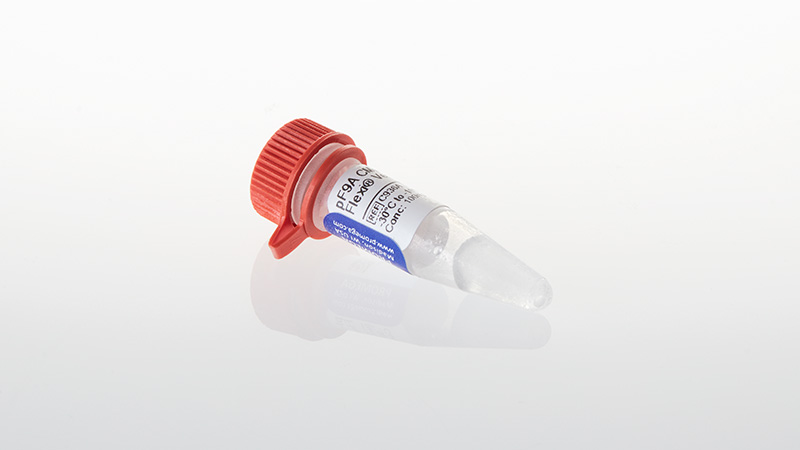
For Expressing Untagged Proteins in Mammalian Cells with Neomycin Selection and <em>Renilla</em> Luciferase
- Offers high-level protein expression from the CMV promoter
- Use Renilla luciferase as a transfection control
- Transfer your cloned insert into other Flexi® Vectors for additional applications (e.g., bacterial or cell-free protein expression) as needed

Catalog Number:
Size
Catalog Number: C9361
The pF9A CMV hRluc-neo Flexi® Vector is designed specifically for high-level expression of proteins in mammalian cells from the CMV promoter with a selectable marker. In addition, the pF9A Flexi® Vector provides Renilla luciferase, which may be used as a transfection control. This vector was designed to complement pGL4 firefly luciferase vectors when exogenous proteins (e.g., a receptor of transcription factor) must be expressed for reporter assays. All inserts may be confirmed by cell-free expression with the TnT® T7 Quick System (Cat.# L1170). There are no licensing fees or complicated transfer restrictions for these vectors. Clone ORFs and conveniently transfer these inserts to a variety of Flexi® Vectors designed for multiple applications.
About the Flexi® Vector System
The Flexi® Vector System is a simple, yet powerful, directional cloning method for protein-coding sequences. It is based on two rare-cutting restriction enzymes, SgfI and PmeI, and provides a rapid, efficient and high-fidelity way to transfer protein-coding regions between a variety of Flexi® Vectors without the need to resequence. Directly use recombinant clones and minimize time wasted screening background colonies. The versatile cloning of the Flexi® system means you can choose from a variety of expression systems and fusion tag orientations and then transfer to others as required. Direct transfers can only occur between two N-terminal tagged vectors or from an N-terminal to a C-terminal vector.
Note: Flexi® Vectors contain the lethal barnase gene to reduce background colonies without inserts during the subcloning procedure. Using the Flexi® Vector Cloning System replaces the barnase gene with your insert. These vectors, as purchased, cannot be cultured in normal laboratory strains of E. coli without an insert.
Ready-to-Use HaloTag® Flexi® Vector Clones
For access to 20,000 human and 15,000 mouse ORF clones with HaloTag® Technology in multiple mammalian expression vectors and custom cloning options, visit: www.kasuza.or.jp.kop/dsearch-e
Sequence Information
pF9A CMV hRluc-neo Flexi® Vector GenBank® Accession Number DQ871024 and vector sequence text file.
Protocols
Specifications
Catalog Number:
What's in the box?
| Item | Part # | Size |
|---|---|---|
|
pF9A CMV hRluc-neo Flexi® Vector |
C936A | 1 × 20μg |
SDS
Search for SDSCertificate of Analysis
Use Restrictions
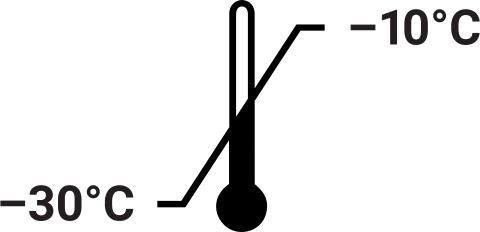
For Research Use Only. Not for Use in Diagnostic Procedures.Storage Conditions
Luciferase Limited Use Label License
BY USE OF THIS PRODUCT, RESEARCHER AGREES TO BE BOUND BY THE TERMS OF THIS LIMITED USE LABEL LICENSE. If the researcher is not willing to accept the terms of this label license, and the product is unused, Promega will accept return of the unused product and provide the researcher with a full refund.
Researchers may use this product for research use only, no commercial use is allowed. "Commercial use" means any and all uses of this product and derivatives by a party for money or other consideration and may include but is not limited to use in: (1) product manufacture; and (2) to provide a service, information or data; and/or resale of the product or its derivatives, whether or not such product or derivatives are resold for use in research. Researchers shall have no right to modify or otherwise create variations of the nucleotide sequence of the luciferase gene except that researchers may: (1) create fused gene sequences provided that the coding sequence of the resulting luciferase gene has no more than four deoxynucleotides missing at the affected terminus compared to the intact luciferase gene sequence, and (2) insert and remove nucleic acid sequences in splicing research predicated on the inactivation or reconstitution of the luminescence of the encoded luciferase. No other use or transfer of this product or derivatives is authorized without the prior express written consent of Promega. In addition, researchers must either: (1) use luminescent assay reagents purchased from Promega for all determinations of luminescence activity of this product and its derivatives; or (2) contact Promega to obtain a license for use of the product and its derivatives. Researchers may transfer derivatives to others for research use provided that at the time of transfer a copy of this label license is given to the recipients and recipients agree to be bound by the terms of this label license. With respect to any uses outside this label license, including any diagnostic, therapeutic or prophylactic uses, please contact Promega for supply and licensing information. PROMEGA MAKES NO REPRESENTATIONS OR WARRANTIES OF ANY KIND, EITHER EXPRESSED OR IMPLIED, INCLUDING FOR MERCHANTABILITY OR FITNESS FOR A PARTICULAR PURPOSE WITH REGARDS TO THE PRODUCT. The terms of this label license shall be governed under the laws of the State of Wisconsin, USA.
U.S. Pat. No. 7,906,282 and European Pat. No. 1341808.
For research use only. Persons wishing to use this product or its derivatives in other fields of use, including without limitation, commercial sale, diagnostics or therapeutics, should contact Promega Corporation for licensing information.
Resources
Software and Firmware
Related Products
Similar Products
Frequently Used With
HaloLink™ Resin
HaloTag® ligand bound to Sepharose beads that specifically and rapidly binds HaloTag® fusion proteins.
G1912, G1913, G1914, G1915
HaloTag® Standard Protein
A 61kDa purified HaloTag®-GST fusion protein supplied at a concentration of 3.0mg/ml. Use to estimate the expression level of your HaloTag® fusion protein.
G4491
BL21(DE3)pLysS Competent Cells
Ready-to-transform E. coli cells with IPTG-inducible protein expression from the T7 promoter.
L1195, L1191
TnT® Quick Coupled Transcription/Translation System
Coupled transcription/translation system that produces significant quantities of protein for applications including GST pull-downs and gel shift assays in 60–90 minutes.
L1170, L1171, L2080, L2081
TnT® SP6 High-Yield Wheat Germ Protein Expression System
A single-tube, coupled transcription/translation system that expresses protein in concentrations of 10–100μg/ml in about two hours. Protein is suitable for applications including high-throughput analysis.
L3260, L3261
HaloTag® Fluorescent Ligands
For protein labeling and detection. Each includes a chloroalkane group for HaloTag® protein attachment.
G8281, G8282, G8591, G8592
HaloTag® Ligand Building Blocks
Enables any reporter, protein or nucleic acid with specified functional groups to be used with HaloTag® protein.
P6711, P6741, P1691, P6751
Anti-HaloTag® pAb
Polyclonal rabbit antibody that specifically detects HaloTag® fusion proteins.
G9281