PKCε Kinase Enzyme System

Easily Screen and Profile PKCε Kinase Inhibitors
- Includes kinase, substrate and reaction buffer
- Use with ADP-Glo™ Assay for bioluminescent detection of kinase activity

Catalog Number:
Size
Additional options
Catalog Number: V4036
Catalog Number: V6473
Catalog Number: V4037
Convenient, Scalable Kinase Profiling
The Kinase Enzyme Systems include a recombinant kinase enzyme, a substrate appropriate for the enzyme, a reaction buffer and supplemental reagents as needed. The PKCε Kinase Enzyme System contains:
- PKCε Kinase, 10μg (Human, recombinant full-length). MW: ~110kDa.
- PKCtide (ERMRPRKRQGSVRRRV) Substrate; derived from protein kinase C epsilon (amino acids 149–164).
- Reaction Buffer, DTT, Lipid Solution.
Recombinant full-length human PKC epsilon (PKCε) was expressed by baculovirus in Sf9 insect cells using an N-terminal GST tag. PKCε is a member of the protein kinase C (PKC) family of serine- and threonine-specific protein kinases that can phosphorylate a wide variety of protein targets known to be involved in diverse cellular signaling pathways. PKCε is involved in many different cellular functions, such as neuron channel activation, cardioprotection from ischemia, heat shock response, as well as insulin exocytosis. Knockout studies in mice suggest that this kinase is important for lipopolysaccharide (LPS)-mediated signaling in activated macrophages and may control anxiety-like behavior.
The PKCε Kinase Enzyme System can be purchased with or without the ADP-Glo™ Kinase Assay reagents. Used together, the ADP-Glo™ Kinase Assay + Kinase Enzyme Systems provide a convenient method for profiling the effect of lead compounds on kinase activity. Assay advantages include broad dynamic range, ease of use and high sensitivity. Kinase Enzyme Systems are manufactured by SignalChem. Bulk quantities available upon request.
Use with ADP-Glo™ Kinase Assay
The ADP-Glo™ Kinase Assay is a luminescent kinase assay that measures ADP formed from a kinase reaction; ADP is converted into ATP, which is a substrate in a reaction catalyzed by Ultra-Glo™ Luciferase that produces light. The luminescent signal positively correlates with ADP amount and kinase activity. The assay is well suited for measuring the effects of chemical compounds on the activity of a broad range of purified kinases, making it ideal for both primary screening as well as kinase selectivity profiling. The ADP-Glo™ Kinase Assay can be used to monitor the activity of virtually any ADP-generating enzyme (e.g., kinase or ATPase) using up to 1mM ATP.
See all Kinase Enzyme Systems available from Promega.
Specifications
Catalog Number:
SDS
Search for SDSCertificate of Analysis
Use Restrictions
For Research Use Only. Not for Use in Diagnostic Procedures.Storage Conditions
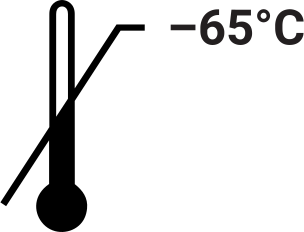
SDS
Search for SDSCertificate of Analysis
Use Restrictions
For Research Use Only. Not for Use in Diagnostic Procedures.Storage Conditions
What's in the box?
| Item | Part # | Size |
|---|---|---|
| PKCε Kinase Enzyme System | V4036 | 1 × 10μg |
|
ADP-Glo™ Kinase Assay |
V9101 | 1 × 1,000 assays |
SDS
Search for SDSCertificate of Analysis
Use Restrictions
For Research Use Only. Not for Use in Diagnostic Procedures.U.S. Pat. No. 7,700,310 and other patents and patents pending.
U.S. Pat. No. 8,183,007 and other patents and patents pending.
Resources
Related Products
Similar Products
Kinase Selectivity Profiling Systems—TK1, TK2, TK3, TK4
Tyrosine kinases and substrates in an 8-tube strip format optimized for kinase profiling.
V6850, V6851, V6852, V6853, V6920, V6921, V6922, V6923
PKCγ Kinase Enzyme System
Includes kinase, substrate and reaction buffer.
V3391, V3392, V9711
PKCι Kinase Enzyme System
Includes kinase, substrate and reaction buffer.
V3751, V3752, V9751
PKCθ Kinase Enzyme System
Includes kinase, substrate and reaction buffer.
V4040, V6475, V4041
Frequently Used With
ADP-Glo™ Kinase Assay
Universal, luminescent kinase activity assay.
V6930, V9101, V9102, V9103, V9104
ADP-Glo™ Max Assay
Luminescent detection of ATPase or kinase activity.
V7001, V7002
GloMax® Navigator System
Dedicated microplate luminometer.
GM2000, GM2010
GloMax® Explorer System
Easy-to-use, flexible multimode detection system.
GM3500, GM3510